
Lilly A Medicine Company logo

Menu

THE IMPACT OF RECURRENCE

Recurrence could set back years of hard work

The Clinical Impact

1 in 3 patients with node-positive, high-risk EBC experience recurrence within 5 years on ET alone1,2

In patients with HR+, HER2– EBC
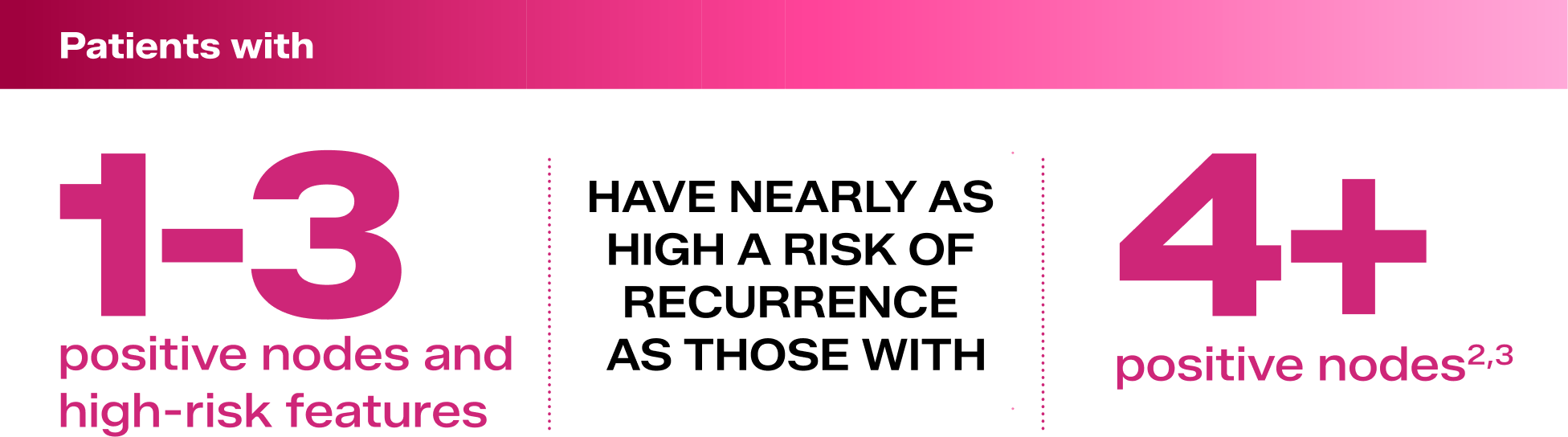
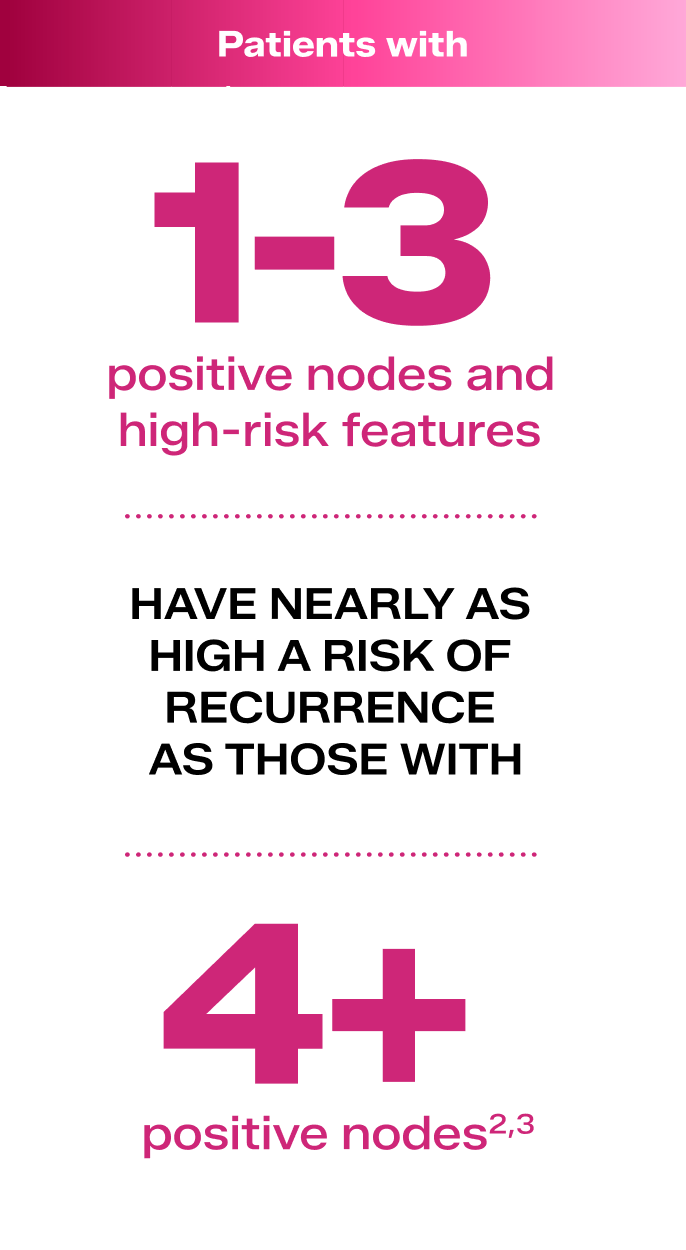
Patients with 1-3 positive nodes and high-risk features have nearly as high a risk of recurrence as those with 4+ positive nodes2,3

When recurrence occurs, it could mean a lifetime of treatment.3,4

Source: US Flatiron EBC Enhanced Data Mart (EDM) (Study period 2011-2020).

This RWE study used the US nationwide Flatiron Health EHR-derived de-identified database. The de-identified data originated from approximately 280 cancer clinics (~800 sites of care), with the majority of patients originating from community oncology settings. This dataset included >15,000 patients diagnosed with HR+, HER2− EBC from January 1, 2011, through February 29, 2024.2,3

Median follow-up: 43 months.2

HRs with 95% CIs were estimated by Cox proportional hazards regression models. Adjustment factors included age, race, menopausal status, resection status, histology, PgR status, BRCA status, ECOG PS, and Oncotype DX Breast Recurrence Score. Adjusted HR describes the increase in recurrence risk in each of the node-positive groups vs each group without these high-risk features over the course of follow-up. Risk of recurrence is the chance of having an event (ie, recurrence or death) and is expressed as 100% minus the 5-year IDFS rate.2,3

Results are based on a post hoc subgroup analysis following the methodology used by Sheffield et al (2022).3 This analysis was exploratory and did not test a hypothesis.2,3

Opening quoteClosing quote

My biggest motivation was staying recurrence-free for my family. I want to be here for as long as possible, sharing family dinners and being part of every moment that matters.

Tina, a real patient diagnosed with HR+, HER2–, high-risk EBC

The emotional impact

For many patients with breast cancer, recurrence is more devastating than the first diagnosis5-8

In addition to its clinical impact, recurrence can take an emotional and psychological toll on patients, causing:

Significant stress5

Increased anxiety6–8

Higher likelihood of depression6–8

The role of CDK4/6is

CDK4/6is can help
Opening quoteClosing quote

I want to live the best version
of my life as possible and
enjoy every moment with my
partner. I’d like to make every
evening feel like date night.

ALLEGRA, a real patient diagnosed with HR+, HER2−, high-risk EBC
BRCA=BReast CAncer gene; CDK4/6i=cyclin-dependent kinase 4 and 6 inhibitor; CI=confidence interval; ECOG PS=Eastern Cooperative Oncology Group performance status; ET=endocrine therapy; HER2−=human epidermal growth factor receptor 2-negative; HR=hazard ratio; HR+=hormone receptor-positive; IDFS=invasive disease-free survival; PgR=progesterone receptor; RWE=real-world evidence.
References:1. Sandoval-Leon A, O'Shaughnessy J, Liepa AM, et al. Exploring the treatment gap in high-risk HR+, HER2- early breast cancer (EBC): eligible patients not receiving abemaciclib in the US. Poster presented at: Miami Breast Cancer Conference (MBCC) 42nd Annual Meeting; March 6-9, 2025; Miami, FL. 2. Tolaney SM, Sammons S, Cortes J, et al. Real-world risk of recurrence by nodal status in patients with HR+, HER2-, node-positive, high-risk early breast cancer. Presented at: San Antonio Breast Cancer Symposium (SABCS) 47th Annual Meeting; December 10-14, 2024; San Antonio, TX. 3. Sheffield KM, Peachey JR, Method M, et al. A real-world US study of recurrence risks using combined clinicopathological features in HR-positive, HER2-negative early breast cancer. Future Oncol. 2022;18(21):2667-2682. doi:10.2217/fon-2022-0310 4. Cheng L, Swartz MD, Zhao H, et al. Hazard of recurrence among women after primary breast cancer treatment—a 10-year follow-up using data from SEER-Medicare. Cancer Epidemiol Biomarkers Prev. 2012;21(5):800-809. doi:10.1158/1055-9965.epi-11-1089 5. Yang HC, Brothers BM, Andersen BL. Stress and quality of life in breast cancer recurrence: moderation or mediation of coping? Ann Behav Med. 2008;35(2):188-197. doi:10.1007/s12160-008-9016-0 6. Stewart RJ, Humphris GM, Donaldson J, et al. Does cancer type influence the impact of recurrence? A review of the experience of patients with breast or prostate cancer recurrence. Front Psychol. 2021;12:635660. doi:10.3389/fpsyg.2021.635660 7. Cohen M. Coping and emotional distress in primary and recurrent breast cancer patients. J Clin Psychol Med Settings. 2002;9(3):245-251. 8. Kenne Sarenmalm E, Öhlén J, Jonsson T, et al. Coping with recurrent breast cancer: predictors of distressing symptoms and health-related quality of life. J Pain Symptom Manage. 2007;34(1):24-39. doi:10.1016/j.jpainsymman.2006.10.017